
Google does not just rank pages. It ranks trust. Here is how guest posting builds exactly the kind of credibility that modern search rewards.
Most bloggers think of guest posting as a link-building tool. A smaller number think of it as an audience-building tool. Almost nobody thinks of it as what it actually is in 2026: one of the most direct and practical ways to build E-E-A-T — the combination of experience, expertise, authoritativeness, and trustworthiness that Google uses to evaluate whether a person or website deserves to rank. This article explains what E-E-A-T actually means in plain language, why guest posting is one of the best ways to demonstrate it, and what to do specifically to make your contributions count.
I want to start with something that confused me for longer than I care to admit. For the first couple of years I was blogging, I thought SEO was fundamentally about pages. You optimised a page. You built links to a page. The page ranked or it did not. The person who wrote it was almost incidental.
Then I started noticing something. Two articles on the same topic, similar length, similar keyword usage, similar backlink profiles – and one consistently outranked the other. The difference, almost every time, was the author. One had a visible track record across multiple publications in the niche. The other had no presence anywhere outside their own site. Google, it turned out, was not just looking at the page. It was looking at the person.
That is what E-E-A-T is really about. Not just whether your article is well-written or thoroughly researched. Whether the person writing it has a demonstrable, verifiable track record of knowing what they are talking about. And the single most practical way to build that track record, faster than almost anything else a blogger can do, is to publish in the right places outside your own site.
What E-E-A-T Actually Means in Plain Language
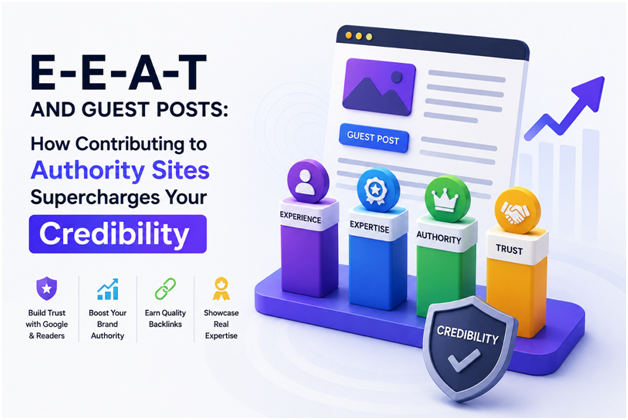
E-E-A-T stands for Experience, Expertise, Authoritativeness, and Trustworthiness. It comes from Google’s Search Quality Rater Guidelines – an internal document that human reviewers use to evaluate search result quality. It is not a direct ranking signal in the way that a backlink or page speed is. It is more like the philosophy behind a collection of signals that Google’s algorithm does respond to.
Here is what each component means in practical terms for a blogger:
Experience – First-hand Experience: Have you actually done the thing you are writing about? A cooking blogger who writes from years of cooking is demonstrating experience. An article assembled from other articles is not. Google increasingly distinguishes between these two types of content, particularly in categories where firsthand knowledge matters.
Expertise – Depth of Knowledge: Do you understand the topic beyond surface level? This shows up in the specificity of your examples, the accuracy of your claims, and the depth of your analysis. Expertise is demonstrated through content quality, not credentials alone.
Authoritativeness – Recognition by Others: Have other respected sources in your niche recognised your work? This is where guest posting becomes directly relevant. A byline in a respected publication is a third-party endorsement of your authority on a topic. It tells Google that someone with editorial standards vouched for your expertise.
Trustworthiness – Accuracy and Transparency: Are your claims accurate? Do you cite sources? Is it clear who you are and what your relationship to the topic is? Trust is built through consistency, transparency about your identity and background, and a track record of not publishing things that turn out to be wrong.
Why Guest Posting Is One of the Most Direct E-E-A-T Signals You Can Build
Of the four components above, Authoritativeness is the one that is hardest to build on your own site alone. You can demonstrate Experience through the specificity of your writing. You can demonstrate Expertise through the depth of your research. You can demonstrate Trustworthiness through accuracy, citations, and transparency. But Authoritativeness requires external validation. It requires other people – specifically, other respected people in your space – to recognise your knowledge as worth publishing.
A guest post on a well-regarded publication in your niche is exactly that recognition, formalised and indexed. The editorial team read your pitch, evaluated your idea, reviewed your article, and decided it was worth putting their name next to. That chain of decisions is, in essence, a trust signal. Google can see that it happened. It can see the byline, the author page, the contextual link back to your site. It factors this into how it evaluates your overall authority on the topic.
I noticed this effect most clearly about four months after I started contributing to publications in my niche. Articles on my own site that had been sitting in positions eight to twelve for competitive keywords started moving. Not dramatically overnight – this is never an overnight thing – but consistently upward over about six weeks. I had not changed the articles themselves. I had not built new links to them directly. What had changed was the broader picture of who I was as an author in my field, which was now visible to Google across multiple trusted platforms.
The Author Page Problem Most Bloggers Ignore
Here is something specific that most guest posting advice never mentions. When you contribute to an external publication, most sites give you an author page – a dedicated URL that lists your contributions and usually carries a short bio. That author page is indexed by Google. It is a structured entity that connects your name to a set of published articles on a credible domain.
The problem is that most guest contributors treat the author bio as an afterthought. They paste in the same generic three sentences they use everywhere and link to their homepage. This is a wasted opportunity on multiple levels.
Your author bio on an external site is one of the places where Google looks to understand who you are as an author. A bio that clearly states your specific area of expertise, mentions your professional background where relevant, and links to a page on your site that reinforces that expertise gives Google something concrete to work with. A bio that says ‘John writes about marketing and loves coffee’ gives Google almost nothing.
Spend ten minutes on the author bio every time you contribute somewhere new. Name your specific expertise. Mention relevant background. Link to the most authoritative page on your own site for that topic. These small investments aggregate into a clearer author entity over time, and a clearer author entity is a stronger E-E-A-T signal.
What to Write to Make Your E-E-A-T Signal Stronger
Not all guest posts build E-E-A-T equally. The type of content you contribute matters as much as where you contribute it.
First-person experience is the most powerful signal.
Google’s addition of Experience to the framework was a direct response to content farms producing technically accurate articles with no firsthand knowledge behind them. A guest post that describes what you personally tested, tried, built, or discovered is categorically different from a post that synthesises what others have found. Write from direct experience wherever you honestly can.
Original data and research amplify authority fast.
An article that presents findings from a survey you ran, an experiment you conducted, or data you collected and analysed establishes you as a primary source rather than a secondary commentator. Primary sources rank better. They get cited more. They build E-E-A-T faster than any other content type.
Depth signals expertise more reliably than length.
A 900-word article that covers one specific aspect of a topic with genuine depth and precision demonstrates more expertise than a 2,000-word overview that skims everything. When you pitch a guest post with an E-E-A-T goal in mind, go narrow and deep rather than broad and shallow.
Consistency in a niche compounds faster than variety.
Contributing to multiple publications on the same topic builds a much stronger authority signal than contributing to one publication on many different topics. Google is building an entity around your name. The more consistently that entity is associated with one specific area, the clearer and more authoritative the signal becomes.
The Long Game: What E-E-A-T Actually Looks Like After a Year
I want to close with something practical, because E-E-A-T can start to feel abstract when you are twelve months into building it and wondering whether anything is happening.
After roughly a year of consistent guest posting in a focused niche – three to four quality contributions per quarter on publications with genuine editorial standards – the effects become visible and measurable. Your name starts to appear in Google’s Knowledge Graph for searches related to your niche. Your own articles start ranking for terms that would have been out of reach when your author profile was thin. You get cited in other people’s articles without asking. Editors reach out to you rather than the other way around.
None of that happens fast. All of it happens reliably when the strategy is consistent. The bloggers who build the strongest E-E-A-T profiles are not the ones who publish the most content. They are the ones who show up repeatedly, in the right places, with something genuinely worth reading – and do it long enough for the pattern to become unmistakable.
That is the real case for guest posting in 2026. Not the backlinks, though those matter. Not the traffic, though that matters too. The reputation. The cross-web presence that tells every algorithm and every reader that this person knows what they are talking about – and has been proving it, consistently, in places that people trust.
Your E-E-A-T Snapshot: Four Questions to Ask Yourself Today
If someone Googled your name, would they find you on more than one trusted site?
If the answer is no, your Authoritativeness signal is thin. The fix is three to four quality guest contributions over the next two quarters, consistently in the same niche. One per month on a credible publication changes this picture faster than almost anything else you can do.
Does your author bio on external sites clearly state your specific expertise?
If it is vague or generic, you are leaving E-E-A-T signal on the table. Update every author bio you control this week. Specific expertise, relevant background, and a link to your strongest topical page on your own site. Ten minutes per site, significant cumulative impact.
Are your guest posts written from personal experience or assembled from research?
Research-based articles are fine. Experience-based articles build E-E-A-T faster. For your next pitch, find an angle that draws on something you personally tested, tried, or observed. That firsthand quality is exactly what the Experience component of E-E-A-T is looking for.
Are you contributing consistently to the same niche or spreading across different topics?
Consistency compounds. If your external contributions are spread across three or four different topic areas, your authority signal in each one is diluted. Pick the niche that matters most to your business or blog and concentrate your guest posting there for the next six months.
Contributed by GuestPosts.biz